
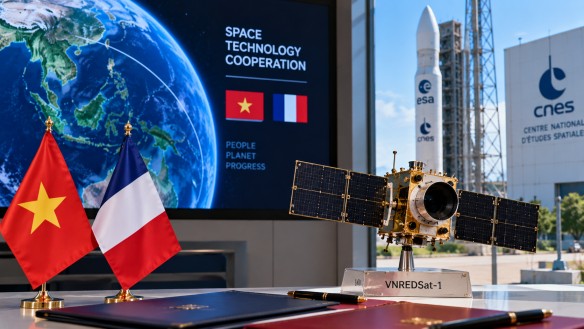
Since its launch on May 7, 2013, Vietnam’s VNREDSat-1 satellite has played a pivotal role in fostering collaboration between Vietnam and France in the realm of space technology. This satellite, Vietnam’s first dedicated to Earth observation, was handed over for operation in September of the same year, surpassing its initial five-year lifespan to remain operational in 2026. This program has not only extended Vietnam’s capabilities in satellite technology but has also laid the groundwork for future projects focusing on advanced satellite development, technology transfer, and the enhancement of domestic expertise.
The VNREDSat-1 program marked a significant milestone for Vietnam, extending its impact beyond mere satellite operation. From 2011 to 2013, Vietnamese engineers received rigorous training both in France and Vietnam, equipping them with skills in system design, satellite operations, and problem-solving. This training empowered them to independently address technical challenges, showcasing a transition from relying on transferred methods to developing indigenous solutions. The program also saw the establishment of a comprehensive remote-sensing system in Vietnam, capable of handling everything from satellite control to data distribution. Since 2020, the satellite has provided nearly 30,000 images for various purposes including environmental management, disaster monitoring, research, socio-economic development, and security.
Trần Hồng Thái, President of the Vietnam Academy of Science and Technology, emphasized that while the program has built a critical foundation in technical skills and human resources for future satellite initiatives, achieving technological self-reliance will necessitate further advancements. Areas identified for growth include satellite design, payload development, electronics, software, and ground systems. The ultimate aim is to enhance Vietnam’s ability to independently design, operate, and develop future satellite technologies.
A new chapter in Vietnam-France space cooperation began during French President Emmanuel Macron’s visit to Vietnam in May 2025. This visit culminated in a declaration of intent signed by the Vietnam Academy of Science and Technology, Airbus Defence and Space, and the French National Centre for Space Studies. This agreement aims to explore the development of a next-generation Earth observation system and the potential VNREDSat-2, emphasizing greater Vietnamese involvement in mission planning, system design, and data applications.
The broader vision for Vietnam’s future in space technology is to transition from acquiring complete satellite systems to actively co-developing and mastering the technology. This shift aims to empower Vietnamese scientists and engineers to progressively take on the roles of designers, operators, and developers, thereby enhancing the country’s autonomy in satellite technology. Areas such as remote-sensing image processing, artificial intelligence, and sensor payloads present promising opportunities for Vietnam to strengthen its domestic expertise and technological self-reliance.